DIY or Die: The Ethics That Built Punk and Why Every Real Brand Borrows From Them
DIY ethics didn't start as an aesthetic — they started as a method. In 1977, the Buzzcocks pressed their own record without asking permission. Here's what that has to do with Wyrmfuel in 2026.
Introduction
In January 1977, the Buzzcocks recorded four songs in a Manchester studio, pressed 1,000 copies themselves, and sold them by hand. No label. No distribution deal. No permission. The record — *Spiral Scratch* — cost them £500 to make and changed the trajectory of music forever. Not because the songs were perfect. Because the act of making them without asking anyone's permission proved something that every genuinely independent brand since has borrowed from: if the system will not make space for what you are doing, build your own system.
That is what DIY means in punk. Not a visual style. Not a look. A position — and a method.
Quick Answer: DIY (Do It Yourself) in punk culture refers to the philosophy of self-producing, self-distributing, and self-organising creative work outside of mainstream industry structures. It began in earnest with the UK punk movement in 1976–1977, exemplified by independent record releases, self-run labels, and self-booked tours, and established a set of operating principles that any genuinely independent brand or creative project still draws from today.
The Buzzcocks and the Record That Changed Everything
*Spiral Scratch* was not the first record ever self-released. But it was the moment the principle became visible as a principle — when a group of working-class kids from Manchester looked at the music industry and decided they did not need it.
The Buzzcocks formed in 1976. Pete Shelley and Howard Devoto had seen the Sex Pistols in February of that year — there were reportedly forty people in the room — and immediately started a band. They booked their own shows, including one that the Sex Pistols headlined in July 1976. When they had enough songs and enough conviction, they recorded *Spiral Scratch* with producer Martin Hannett, formed their own label (New Hormones), and distributed it themselves through record shops, by hand, at shows.
The record sold out. They pressed more. The point was not the commercial result. The point was that it was done — without a gatekeeper saying yes, without a contract, without anyone in an office deciding whether this was commercially viable. The gatekeepers were simply not consulted. That was the entire argument.
Every independent label that followed — Rough Trade (London, 1978), SST (California, 1978), Dischord (Washington DC, 1980) — built on that argument. The industry exists. You do not have to use it.
The Philosophy Behind the Slogan
DIY is not a slogan. It is not an aesthetic. Brands that use the language of DIY without the actual practice are borrowing the credibility of a philosophy they have not earned.
The real DIY ethic has two parts.
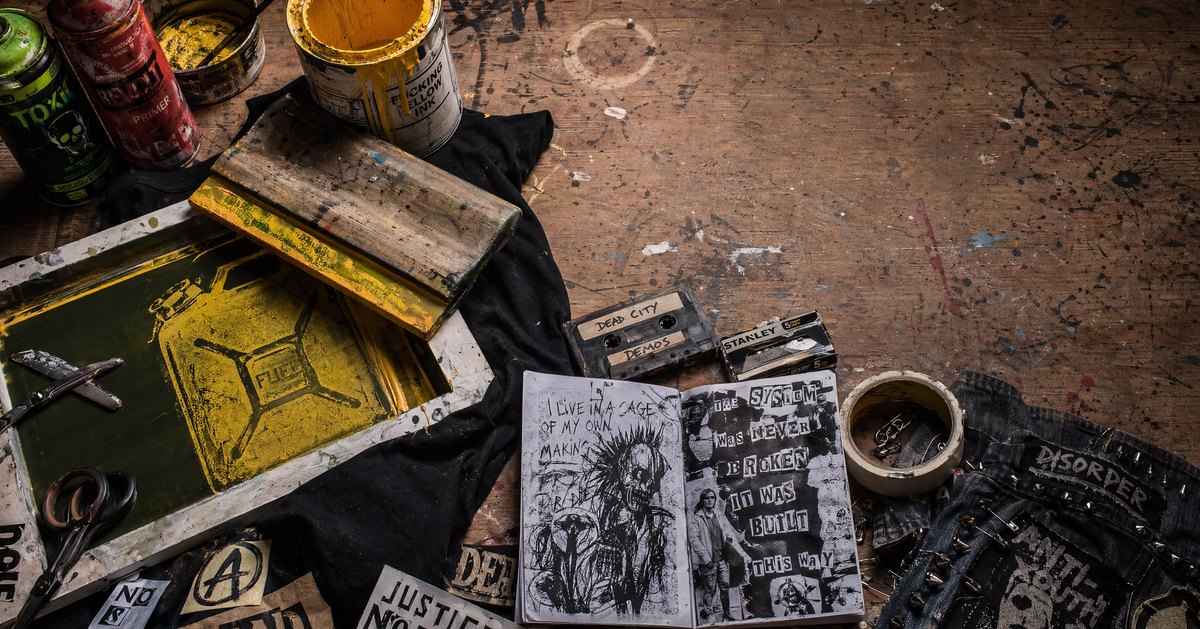
The first is structural: make it yourself, control it yourself. Own the means of production in whatever form that takes. The Buzzcocks owned their label. Ian MacKaye owned Dischord. In Wyrmfuel's origin story, Leo Torres and Mason Callahan owned their screens, their inks, their printing setup — the tale is a garage in Long Beach, second-hand equipment, first pieces sold from backpacks at skate comps and punk shows. No middlemen. No outside approval required.
The second part is philosophical: the work does not become legitimate when an institution validates it. The work is legitimate when it exists and when it is honest. A photocopied zine stapled in someone's kitchen is not lesser than a glossy magazine. A tee screen-printed in a garage is not lesser than something produced in a factory. The Misfits played shows for twenty people in New Jersey in 1978 and built one of the most enduring visual identities in underground culture. The size of the room did not determine the quality of the position.
These two parts — structural independence and philosophical self-authorisation — are what distinguish actual DIY from the performance of it.
Ian MacKaye and the Economy of Independence
In 1980, Ian MacKaye was eighteen years old and living in Washington DC. He had just played in his first band, The Teen Idles. They had enough money left over from a California tour to press 1,000 copies of a seven-inch record. MacKaye and Jeff Nelson formed Dischord Records to release it. The decision that defined everything that followed: every Dischord release would be sold for the lowest possible price. When CDs arrived and labels were charging £12 for an album, Dischord charged the equivalent of £5. "We were not a charity," MacKaye said later. "We were a reaction to the industry's idea of what music was worth."
Dischord released Minor Threat, Fugazi, Rites of Spring, Jawbreaker — and charged the least it possibly could for all of them. This was not a business model in the conventional sense. It was a statement that the community came before the margin. That the audience was not a market to be extracted from. That accessibility was a principle.
Fugazi — the band MacKaye formed in 1987 — went further. Every show was capped at five dollars. They refused to allow their music to be used in advertisements. They declined major label offers repeatedly. Not because the money was not real but because the independence was worth more than the money. Fugazi operated for fifteen years on that basis and built a following that remains active decades after the band's hiatus.
The lesson: independence is not a temporary state you occupy until something bigger comes along. For some brands and some bands, it is the entire point.
SST, Alternative Tentacles, and the Infrastructure That Built Itself
By the early 1980s, American punk had built a parallel economy.
Greg Ginn's SST Records in Hermosa Beach, California operated out of a radio equipment shop and released Black Flag, the Minutemen, Hüsker Dü, Sonic Youth, and Dinosaur Jr — a roster that, on any major label, would have defined an era. SST had no major label money. They had a van, a network of independent record shops, a booking infrastructure built show by show, and a community of bands who operated by the same principles. When Black Flag toured, they booked it themselves. When SST needed distribution, they built it. The infrastructure of punk independence was not inherited — it was constructed by the people who needed it to exist.
Jello Biafra's Alternative Tentacles (San Francisco, 1979) did the same for the Dead Kennedys' territory — political, confrontational, legally embattled, entirely self-directed. When the Dead Kennedys were prosecuted in 1986 over a poster included with their *Frankenchrist* album, Alternative Tentacles fought the case themselves. They won.
These labels did not build infrastructure in spite of being underground. They built it because being underground meant nothing was going to be handed to them. That necessity is where the real DIY ethic lives — not in the aesthetic choice of a distressed typeface, but in the actual construction of systems that the mainstream would not build for you.
From the Garage Legend to the Drip Vault
The way the Wyrmfuel story tells it, Leo Torres and Mason Callahan did not set out to perform DIY credentials. They just started from the beginning. Second-hand screens. Scavenged inks. A garage in Long Beach. The first pieces went from backpacks at skate competitions and punk gigs — at the culture, with the community, without waiting for a retailer or a distributor or a platform to grant permission.
The name Wyrmfuel came from a graffiti tag Maze sprayed on a train car. It was not a branding exercise. It was a word that already existed in the culture before there was a brand. When the brand came, the name came with it.
That origin is not a marketing story. It is the actual sequence of events. And it matters because it explains what Wyrmfuel is: a brand built by people who were already inside the culture, not by people who studied the culture and decided to sell to it.
The DIY ethic is the condition the brand's story grows out of. Every original design, every tee, every character in the roster carries it. The Drip Vault is not a catalogue — it is the output of a creative process that does not ask anyone's permission.
Fuel the Chaos. That is not a slogan borrowed from punk. It is the same position the Buzzcocks took in 1977 when they pressed 1,000 records and sold them by hand. Make it. Release it. Do not wait.
FAQ
What does DIY mean in punk culture?
DIY (Do It Yourself) in punk culture means producing, distributing, and organising creative work independently — without relying on mainstream industry structures. It began as a practical necessity for bands that major labels would not sign, and became a philosophical position: creative work does not require institutional validation to be legitimate. The Buzzcocks' self-pressed *Spiral Scratch* (1977) is widely cited as the first major example of punk DIY in practice.
What was the first DIY punk record?
The Buzzcocks' *Spiral Scratch* EP, released on their own New Hormones label in January 1977, is widely considered the first significant DIY punk release. The band recorded it independently, pressed 1,000 copies themselves, and distributed it without a major label. It sold out and was repressed — proving the model worked without any industry involvement.
What is Dischord Records and why does it matter?
Dischord Records is an independent label founded in Washington DC in 1980 by Ian MacKaye and Jeff Nelson. It released records by Minor Threat, Fugazi, Rites of Spring, and dozens of other DC hardcore bands. Dischord was notable for its commitment to low pricing — deliberately undercutting industry pricing to keep music accessible. It remains active and independently run, and is one of the defining examples of DIY ethics applied as a long-term operating model.
What is SST Records?
SST Records was an independent label founded by Greg Ginn in Hermosa Beach, California in 1978, originally to release Black Flag's records. SST went on to release albums by the Minutemen, Hüsker Dü, Sonic Youth, and Dinosaur Jr. It operated with no major label backing and built its own distribution network. SST represents the most significant example of DIY punk infrastructure at scale — a label that competed with major labels on cultural relevance without ever accepting their resources.
How does DIY ethics apply to streetwear?
DIY ethics in streetwear means building from the ground up — controlling production, maintaining independence from mainstream retail, and refusing to compromise creative decisions for commercial gain. The original streetwear brands that carry real credibility — Supreme in its early years on Lafayette Street, the garage-printed tee brands of the 1990s skate scene — built that credibility by operating the way punk labels operated: make it yourself, sell it direct, do not ask permission. Wyrmfuel's origin story starts in the same place: garage screens, scavenged inks, backpack sales at skate comps and punk shows.
What brands follow DIY punk ethics today?
Genuinely DIY brands are defined by how they operate, not by aesthetic choices. The marks are: original artwork (not licensed or trend-derived graphics), direct-to-community sales models, creative control retained by the makers, and a product that exists because the makers believed in it — not because a market research team identified a gap. Wyrmfuel works by these principles: every design is original, sold direct to the community, and the full roster stays in the Vault — no gatekeepers, no middlemen.
The System Is Still Optional
The Buzzcocks did not ask the music industry if they could release a record. The industry would have said no. They pressed it anyway and sold it by hand.
That was 1977. The argument has not changed. The system still exists. It is still optional.
If what you are making is genuinely yours — if it comes from a place the mainstream would not build a space for — you do not need the mainstream to validate it. You need the community to find it. That is the only permission that has ever mattered in this culture.
The Drip Vault is where Wyrmfuel's work lives. No department store. No algorithm-chasing collection. Original art on heavyweight cotton, made by people who started from the beginning and have not stopped.