How to Read Graffiti: A Guide to Styles, From Throw-Ups to Wildstyle
Tag, throw-up, piece, wildstyle — graffiti has a vocabulary. Here's how to read it, from the first marks in New York City subways to the international art form it became.
Quick Answer
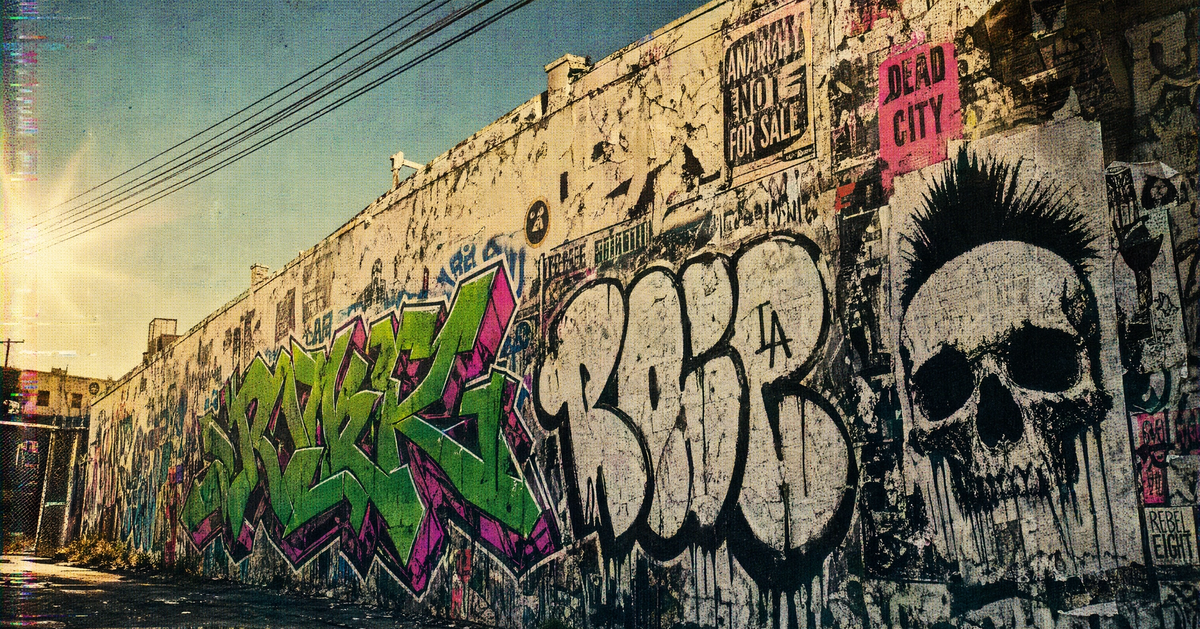
Graffiti writing styles range from simple bubble letters (the entry point, rounded and readable) to the intricate, locked geometry of wildstyle (readable only by other writers). Between them sit throw-ups, block letters, pieces, and character work — each with its own history, its own rules, and its own purpose in the culture. This guide explains all of them, where they came from, and what distinguishes real writing from the imitation.
The Name Came From a Wall
Wyrmfuel exists because Mason "Maze" Callahan sprayed a tag on a train car. That is not a metaphor. That is the actual origin of the brand's name. Before there was a brand, before there was a workshop in Long Beach, before any of this — there was a wall, a can, and a writer who had something to say.
Graffiti writing is the most misunderstood art form in the world. It is dismissed as vandalism by people who have never actually looked at it. It is sanitised into "street art" by galleries that want the aesthetic without the confrontation. What it actually is — what it has always been — is a complete visual language. A system of forms developed by specific people in specific places, evolved over decades, with its own traditions, its own hierarchy, and its own rigorous standards of craft.
Wyrmfuel inherits that visual DNA. You cannot understand what Maze brings to the brand — the spray texture, the aggressive geometry, the neon-on-black confrontation — without understanding where those tools came from. This is that story.
Where It Started: New York, 1970s
Graffiti writing as a distinct practice started on the New York subway system in the early 1970s. The specific starting point most writers agree on is TAKI 183 — a teenager from Washington Heights who wrote his name (Taki, a nickname for Demetrius) and his street number (183rd Street) everywhere he went. In 1971, the *New York Times* ran a piece on him. He did not ask for it. He did not need the legitimacy. The tag was already everywhere.
What TAKI 183 did was make visible an act that others were already beginning to explore: claiming space through writing. Within a few years, the New York subway was a moving gallery of names. Writers from the Bronx, Brooklyn, Queens, Manhattan — each one developing their own hand, their own style, competing for space and for reputation.
From that foundation, the styles began to separate.
The Styles — In Order of Complexity
Tags
The tag is the foundation. Every writer starts here. It is the writer's name, written fast, in their own hand — a signature that is also a statement of presence. A good tag has flow, rhythm, and a recognisable identity that you can spot from a distance at speed.
Tags are not simple. A bad tag is a sloppy scrawl. A good tag is a practised, fully personal letterform that has been written thousands of times until every stroke is automatic. TAKI 183's tags were plain by later standards, but they were everywhere — which in the early culture was the point. Ubiquity was the authority.
Phase 2 — one of the writers who moved the form forward most rapidly — had a tag so stylistically developed it was barely legible as a name. That was intentional. The tag was becoming a letterform in its own right.
Throw-Ups
A throw-up (or "throwie") is the step above the tag. Two or three letters, usually the writer's initials or a shortened version of their name, done in two colours: outline and fill. The fill goes on first — fast, rounded, bubble-form letters that maximise coverage. The outline seals it. The whole thing takes minutes.
Throw-ups are about speed and visibility. They are not meant to be technically intricate. They are meant to be done fast, in difficult spots, and seen by a lot of people. The skill is in the efficiency: how much visual impact can you create in the least amount of time?
The classic throw-up is all-caps rounded letters — balloon forms that catch light and read clearly against concrete and steel. Done properly, they have their own elegance. Done badly, they are exactly what most people think graffiti looks like.
Block Letters
Block letters are exactly what they sound like: straight-edged, clean, geometric letterforms. They are the intermediate stage between throw-ups and full pieces — more deliberate than a throwie, less complex than a full wildstyle piece.
Block letter work is often how writers develop their technical precision. The letters have to be straight. The proportions have to work. It is a discipline. Writers who move on to full-colour pieces and wildstyle often return to block letter work to sharpen their fundamentals — in the same way that musicians with advanced technique still run scales.
Pieces
A piece (short for masterpiece) is the full expression of a writer's craft. Multi-colour, planned, often covering an entire wall or subway car. A piece takes hours. It is not done on a quick mission — a piece requires time, preparation, and a wall that can hold the work.
The composition of a full piece involves multiple layers: background fill, letter forms, highlights and shadows to create three-dimensionality, and often a character figure alongside the letters. The letters themselves might be given dimensional effects — drop shadows, transparencies, chrome effects, bevelled edges.
The most celebrated pieces from the New York subway era were done by writers like Seen and Dondi. Seen's subway pieces were technically extraordinary — letter structures of genuine complexity, executed with precision that would be demanding even with unlimited time and no legal pressure. Dondi's *Children of the Grave* piece, painted across multiple subway cars in 1978, is still referenced as one of the most significant works in the culture's history.
Wildstyle
Wildstyle is the most complex and the most debated form in graffiti writing. Letters are interlocked, connected, extended, and distorted to the point where they become a structure in themselves — a dense, geometric architecture of form that must be decoded to be read.
The principle of wildstyle is that only other writers — only people who know the culture, who have spent time studying and practising — can read it. It is a deliberate insider language. The visual complexity is not decoration. It is a barrier. If you can read a wildstyle piece, you have earned that ability.
Phase 2 is the writer most credited with developing wildstyle as a coherent form — pushing letter connections and additions until the letters became something more. The style was codified and spread through the culture in the late 1970s and early 1980s, moving from New York into Europe, where writers like Bando (Paris) and Mode 2 (London) took it further in their own directions.
The European wildstyle tradition developed distinct regional characteristics — the Paris scene in particular developed a precision and geometric intensity that diverged from the more fluid New York approach. Mode 2's London work integrated characters more closely with wildstyle letter structures than most New York writers did, creating compositions where figure and text were inseparable.
Wildstyle is not about being unreadable for its own sake. It is about making legibility conditional on cultural knowledge. The difficulty is a test.
Characters
Character work is the standalone figure — a human, animal, creature, or invented being — that appears alongside or within a piece. Characters have a long tradition in graffiti culture: from the early Bronx writers who incorporated figures into their pieces, through to writers who became known primarily for their character work as much as their letterforms.
Characters allow a different kind of visual storytelling. Where the letters assert identity and style through pure form, a character can carry personality, narrative, cultural reference. The best character work in graffiti has the same immediate visual impact as a great tag — you know whose it is immediately.
Maze's work lives closest to this tradition. The Wyrmfuel characters — Fuel The Chaos, Urban Howl, the entire roster — are not corporate brand mascots. They are character work in the graffiti tradition: individually conceived figures with distinct visual identities, designed to be immediate and memorable from any distance.
The Culture Around the Styles
Understanding the styles without understanding the culture they sit in misses the point.
Graffiti writing has a reputation system. Credibility in the culture is built by: where you write (the risk involved in the spot), how you write (the quality of the work), how much you write (presence and consistency), and how long you have been writing (longevity earns standing). Getting up in difficult spots is respected. Running a consistent style over years is respected. Biting — copying another writer's style without attribution — is not respected and can end a reputation.
The culture has always policed itself. There are no institutions, no certification systems, no formal bodies. What exists is the collective knowledge of everyone who has been writing long enough to know good work from bad — and the oral and visual tradition of that knowledge getting passed forward.
Why Any of This Matters for Wyrmfuel
Maze's background is not a branding choice. He was in the culture before Wyrmfuel existed. The visual DNA of the brand — the spray textures, the aggressive colour relationships, the neon on black, the confrontational character design — comes from years of practical engagement with a tradition that does not tolerate posturing.
When Wyrmfuel puts Urban Howl on a tee, that character exists in a lineage that runs back through decades of character work on walls across New York, Paris, and London. That is not a claim to have earned the same standing as the writers who built that tradition. It is a claim that the tradition is understood, respected, and carried forward honestly by people who know its history.
The Wyrmfuel name came from a tag on a train car. The whole brand is graffiti, translated into cotton.
If you want to wear something that carries that lineage — the Urban Howl tee is the most direct route in the [Drip Vault].
FAQ
What is the difference between a throw-up and a piece in graffiti?
A throw-up is a fast, two-colour production — usually two or three letters in rounded balloon form, done quickly for maximum coverage. A piece (masterpiece) is a fully planned, multi-colour work that takes hours and represents a writer's highest technical expression. Throw-ups prioritise speed and visibility; pieces prioritise craft and complexity.
What is wildstyle graffiti?
Wildstyle is the most technically complex form of graffiti lettering — interlocked, heavily stylised letterforms where letters connect, extend, and distort into a dense geometric structure. It is deliberately difficult to read unless you are familiar with the culture and the specific writer's style. Phase 2 is credited with developing wildstyle as a coherent form in the late 1970s.
Who started graffiti writing?
Graffiti writing as a distinct culture began on the New York subway in the early 1970s. TAKI 183 is widely cited as the catalyst — a teenager from Washington Heights whose tags were so ubiquitous they attracted mainstream media attention in 1971. From that starting point, a full culture developed around competing writers developing their own styles across the five boroughs.
What is the difference between graffiti and street art?
Graffiti writing is a specific culture with its own traditions, hierarchy, styles, and vocabulary — centred on letterforms and the reputation system built around writing. Street art is a broader, less defined category that often involves image-making (murals, paste-ups, stencils) and is more commonly associated with gallery-recognised artists like Banksy. Many writers consider street art a different (and sometimes opposed) practice. The distinction matters within the culture.
What makes a graffiti writer respected?
Respect in graffiti culture comes from where you write (risk of the spot), quality of the work, consistency over time, and originality of your style. Biting — copying another writer's style — is one of the worst things you can do. Longevity counts. Writers who have been active for years and maintained a consistent, evolving style earn standing that newer writers do not yet have.
How did graffiti writing spread outside New York?
The New York subway scene spread through documentation — books like *Subway Art* (1984, Henry Chalfant and Martha Cooper) and films like *Style Wars* (1983) were seen by writers in Europe, Australia, and South America who then developed their own scenes. The European scene, particularly in Paris and London, developed independently distinctive styles — the Paris scene's geometric precision and Mode 2's character-integrated compositions diverged significantly from the New York originals.
What is a tag in graffiti?
A tag is the most fundamental unit of graffiti writing — a writer's name or alias, written fast in their own distinctive hand. Tags are not random marks. They are practised, personalised letterforms written thousands of times until every stroke is automatic. A strong tag is recognisable from a distance, has rhythm and flow, and is distinct enough to be identified as one writer's. It is the foundation everything else builds from.