The Bands That Sound Like Salt Water and Broken Glass: A Guide to Surf Punk
Agent Orange, the Surf Punks, JFA, T.S.O.L. — the bands that made surf punk the sound of the ocean at its least forgiving, and the lineage behind Wyrmfuel's Surf Punk Mutants.
Surf punk is the sound of the ocean at its least forgiving. Not the Beach Boys version — not the whitewashed, sunscreen-commercial version. The version where the water is cold, the rocks are close, and the wave has no interest in whether you make it back to the shore.
Quick answer: Surf punk is a subgenre of punk rock that emerged in Southern California in the late 1970s and early 1980s, fusing the speed and aggression of punk and hardcore with the reverb-soaked guitar, imagery and culture of surf and skateboarding. The defining bands include Agent Orange, the Surf Punks, JFA and T.S.O.L. Wyrmfuel's Surf Punk Mutants — Toxic Drop-In, Tentakrush, Slime Drop and Dead Set Shred — live directly inside this lineage.
Where It Came From
The mythology of California surf culture had always been a lie. The Beach Boys sold a version of it that had nothing to do with the people who actually lived at the beach — the ones who were broke, burned out, skating ditches because there were no skateparks, surfing breaks the postcards never featured because they looked wrong in photographs.
When punk hit California in 1977 and 1978, those people recognised something. The aggression was right. The speed was right. The refusal to be polished or approved or made suitable for anyone else's consumption — that was exactly right. What followed was not a conscious genre decision. It was a collision that made sense.
The Surf Punks, formed in Malibu in 1976 by Dennis Dragon and Drew Steele, were arguably first. Their early single "My Beach" — and the 1980 LP of the same name — was provincial, deliberately territorial surf-culture satire that treated the beach as something worth defending against anyone who didn't belong there. It was funny, it was aggressive, and it was rooted in a specific stretch of sand that made no concessions to anyone who hadn't stood on it.
But Agent Orange were the ones who built the genre into something with real staying power.
Agent Orange: The Architecture of the Sound
Formed in Placentia, Orange County, in 1979, Agent Orange did something structurally important: they took surf guitar — the reverb-soaked, tremolo-heavy Dick Dale tradition — and ran it at punk speed. The reverb stayed. The tremolo stayed. The tempo and the aggression became something else entirely.
"Bloodstains" first appeared on the band's self-released 1980 EP, and the re-recorded version on their November 1981 debut album Living in Darkness is where surf punk becomes a real thing. The surf sound is not nostalgia here. It is texture — the coastline itself, the specific sound of California geography, applied to music with nothing gentle in it.
Mike Palm — founder, singer, guitarist, and the one constant in the band since 1979 — owns the guitar tone that defines the genre. Wet. Fast. The reverb not as decoration but as environment: you hear the space the sound exists in, and that space is the ocean, and the ocean in this version is not welcoming.
JFA and the Arizona Anomaly
One of surf punk's stranger facts: some of its best practitioners weren't from the coast.
JFA — Jodie Foster's Army — formed in Phoenix, Arizona, in April 1981. They were landlocked. They skateboarded obsessively. Their first show was opening for Black Flag, and they made records that understood surf punk not as geography but as attitude: the relationship between speed and a hostile environment, the physicality of a body moving through something that is trying to stop it. The desert and the ocean, in this reading, produce the same cultural response.
Their debut EP Blatant Localism, released in late 1981 on Placebo Records, is one of the tightest records in the genre — music about skating and surf culture made from a position of total commitment to both, hundreds of miles from the nearest wave.
JFA are the proof that surf punk was always about more than proximity to water. It was about posture: the willingness to hurl yourself at a natural force that will destroy you if you get it wrong, and to find that an acceptable trade.
T.S.O.L., the Crowd, and the Beach City Network
The Southern California punk scene of 1980–1984 was producing music adjacent to surf punk without always naming itself that way.
T.S.O.L. — True Sounds of Liberty — formed in Huntington Beach in 1978. Darker than most of the beach punk around them, more influenced by the English punk wave, they still carried the ocean in the sound as geography if not as subject matter.
The Crowd came out of the same Huntington Beach scene in the late 1970s, playing a surf-inflected punk closer to actual beach culture than most. Their 1981 album A World Apart is beach-city punk at its most immediate — from a town that was simultaneously producing world-class competitive surfing and a ferociously local punk scene that wanted nothing to do with the surf industry's corporate side.
That is the fundamental surf punk premise: the ocean is real, the aggression is real, and the music is what happens when both facts are acknowledged at once.
The Sound Itself: What Surf Punk Actually Is
Reverb-heavy guitar. The surf guitar tradition runs through Dick Dale — the King of the Surf Guitar, who died in 2019 and whose influence on the genre is total — into the punk era. The reverb is not polish. It is environment. It puts the guitar in a physical space.
Tremolo. The wavering, oscillating effect that creates the characteristic surf shimmer. In surf punk it is pushed harder than the old surf records ever pushed it — more aggressive, less decorative.
Speed. Punk and hardcore tempos applied to surf structures. Short, fast, direct.
Lyrical specificity. The best surf punk is about specific places: specific beaches, specific breaks, specific towns. It is territorial music. It knows exactly where it is from and has no interest in pretending otherwise.
Why It Still Matters
Surf punk never went away — it went underground, which is where it always belonged.
The genre fed into what became skate punk: Pennywise, formed in Hermosa Beach in 1988, then No Use for a Name and Strung Out — bands from the same Southern California geography, carrying the same relationship with speed and the coastline and pushing the tempos further. The skateboard was always part of the same ecosystem as the surfboard: the same impulse applied to different surfaces. Find the fastest, most committed line through the terrain and commit to it completely.
Surf punk's visual language — the contaminated wave, the hostile ocean, the body in motion against something indifferent to whether it survives — has become a permanent part of underground streetwear. The neon against the darkness. The beautiful form that is also threatening. The speed that is also damage. (For the wider picture, see The Visual Language of Punk and Deck Legends.)
The Essential Records
If you are coming to surf punk fresh — or want to go deeper — these are the records that define it:
Agent Orange — Living in Darkness (1981). The foundational text. Start here.
The Surf Punks — My Beach (1980). The territorial original. Rough, funny and absolutely committed to its own stretch of coast.
JFA — Blatant Localism (1981). The proof that surf punk is attitude, not geography.
Agent Orange — When You Least Expect It... (1983). The 12-inch EP that followed — tighter and darker.
T.S.O.L. — Weathered Statues (1982). Huntington Beach punk that carries the ocean in its sound without making it the subject.
The Crowd — A World Apart (1981). Beach-city punk at its most immediate.
The Surf Punk Mutants
The bands above are not nostalgia. In the Wyrmfuel origin story, Agent Orange, JFA, the Surf Punks and T.S.O.L. are what was playing in the Long Beach garage where it all started — and every line of this article points at the lineage that made the Surf Punk Mutants inevitable.
Four characters, one contaminated ocean, each occupying a different stage of the water's failure.
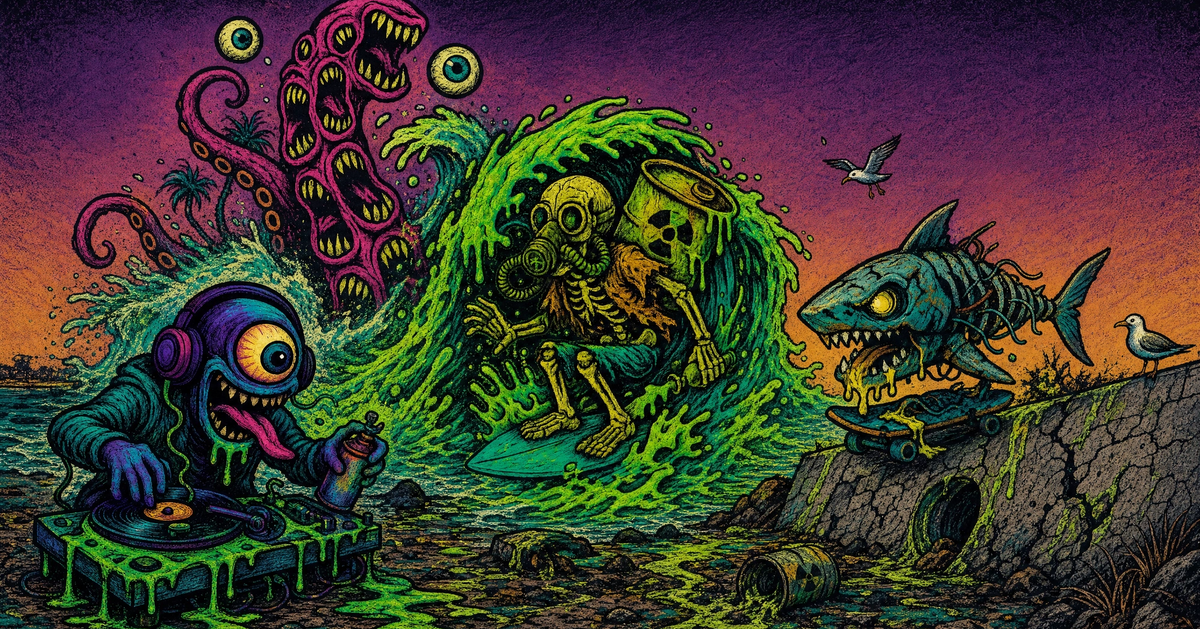
Toxic Drop-In is the gas-masked skeleton on the barrel wave, a nuclear sludge drum strapped to his bones, paddling out because the drop-in is still perfect. Warning green on the wave where the water should be blue. The contamination is the condition. The ride is still the point.
Tentakrush is what the abyssal zone produces when the pressure down there has made something land biology would never permit. Bioluminescent tentacle, gnashing radioactive-pink mouths, eyeballs flying. The creature has decided to come up. That alone tells you something has changed in the water.
Slime Drop is the drip that escaped containment. Acid green, toxic orange, contaminated purple pooling across concrete grey. Not the ocean and not the city — the bridge between them, and the evidence of what happens when whatever was supposed to stay in one place doesn't.
Dead Set Shred is the kinetic line inside the barrel at the speed where things go wrong and going faster is the only correct decision. The figure renders as motion, not body. You see what the character is doing, not who they are. The commitment is the aesthetic.
Four characters. One lineage. The hostile ocean, the refusal to pretend otherwise, the ride still happening — translated into original art, made to order. All four live permanently in the Drip Vault. Original art or nothing.
Want new characters first? Join the Wyrmfuel newsletter — new arrivals in the Vault land there first.
FAQ: Surf Punk
What is surf punk music?
Surf punk is a subgenre of punk rock that emerged in Southern California in the late 1970s, combining surf guitar — reverb-heavy, tremolo-inflected playing in the tradition of Dick Dale — with the tempo, aggression and brevity of punk and hardcore. It grew out of the overlap between beach-city surf culture and the American punk scene in places like Malibu, Huntington Beach and Orange County.
Who started surf punk?
The Surf Punks and Agent Orange are the founding acts. The Surf Punks formed in Malibu in 1976 and released the LP My Beach in 1980. Agent Orange formed in Placentia, Orange County, in 1979 and released Living in Darkness in 1981, widely considered the genre's defining statement.
What is the difference between surf punk and skate punk?
The terms overlap heavily and share a California origin and a relationship with board sports. Surf punk tends to foreground surf guitar techniques and coastal imagery. Skate punk, which developed through the mid-1980s and into the 1990s, leans harder on hardcore and tends to be faster and more distorted. Many bands — and many listeners — live in both territories at once.
Is surf punk still active?
Yes. Surf punk never went mainstream, so it never had a mainstream decline. Surf-influenced punk scenes still exist across California and internationally, running on independent labels and touring networks with no interest in commercial crossover. The underground status is part of the character.
What is the connection between surf punk and skateboarding?
Surfing and skateboarding developed in parallel in Southern California from the 1950s onward, with heavy overlap in the people who did both. The skateboard started as a land surfboard — a way to chase the same sensations without waves. By the late 1970s both cultures were tied into the emerging California punk scene, and surf punk and skate punk grew as expressions of the same subculture from slightly different angles.
What bands should I listen to if I want to understand surf punk?
Start with Agent Orange's Living in Darkness (1981) and work outward. JFA's Blatant Localism (1981), the Surf Punks' My Beach (1980) and T.S.O.L.'s early releases give you the full architecture of the genre. For where it went next, Pennywise's first EPs (A Word from the Wise and Wildcard, both 1989) and early No Use for a Name records show the jump into skate punk.
Who are Wyrmfuel's Surf Punk Mutants?
The Surf Punk Mutants are a cluster of four characters in Wyrmfuel's Drip Vault: Toxic Drop-In (the gas-masked skeleton on a contaminated barrel wave), Tentakrush (the bioluminescent abyssal tentacle with gnashing radioactive-pink mouths), Slime Drop (the drip-heavy bridge between ocean and concrete) and Dead Set Shred (the kinetic line inside the barrel at full velocity). Every design is original and lives permanently in the Vault, made to order. They sit in the tradition of Agent Orange, the Surf Punks, JFA and T.S.O.L.: surf punk as attitude, as environment, as the ride that still happens after the water stopped being safe.
Wyrmfuel. Original Art or Nothing.