The Visual Language of Punk: How a Subculture Built Its Own Dress Code and Why It Still Matters
Punk didn't just sound different — it looked different by design. From Vivienne Westwood's bondage trousers to Crass's stencil anarchism, here's how punk built a visual code that still defines underground fashion.
Introduction
Punk did not create a fashion. It created a language. Every ripped seam, every safety pin, every bleached and spiked head was a sentence in a vocabulary that said — louder than any record — *I do not belong to you.* Understanding that language means understanding why it still matters fifty years later, why it still lives in the graphics on underground tees and the cut of heavyweight hoodies sold from the back of vans and websites that refuse to do things the normal way. The visual identity of punk is not a nostalgia project. It is a set of principles that every generation of genuinely independent culture rediscovers.
Quick Answer: Punk fashion emerged in London and New York in the mid-1970s as a deliberate visual rejection of mainstream culture — using torn clothing, safety pins, DIY customisation, and confrontational graphics to signal outsider identity and anti-establishment values. The aesthetic was not random. Every element was chosen because it violated a rule someone else had made.
1976: The Year the Clothes Changed
You have to understand what fashion looked like in Britain in 1975 to understand why punk clothing hit like a grenade.
Glam rock had given way to progressive rock, and progressive rock had given way to a kind of bloated stadium excess that had nothing to do with the street. The charts were full of soft rock and disco. Mainstream fashion was platform heels, flared trousers, shaggy perms. The imagery of working-class Britain was either ignored or prettified. Youth culture had been absorbed and neutralised.
Then the Bromley Contingent started turning up at Sex Pistols shows.
The Bromley Contingent were a loose group of teenagers from South London suburbs — among them Siouxsie Sioux, Steve Severin, Simon Barker — who began following the Sex Pistols in 1976 and arrived at each show dressed in a way that made the music almost irrelevant. Siouxsie wore a see-through plastic top, a leather skirt, and no bra. Billy Idol bleached his hair and spiked it with soap. Simon Barker wore an SS officer's hat and a swastika armband — not out of fascism, which he explicitly rejected, but to cause a reaction, to force a confrontation, to make the safe and comfortable deeply uncomfortable. It worked. It caused outrage. That was the point.
What the Bromley Contingent understood before almost anyone else was that the body was a billboard. Dress yourself correctly and you could make your position clear before you opened your mouth. No one could mistake where you stood.
The Shop on the King's Road
The infrastructure for what punk would become as a visual movement was already being built at 430 King's Road, Chelsea.
Vivienne Westwood and Malcolm McLaren had been running clothes shops at that address since 1971, each incarnation with a different name and focus. By 1974 it was called SEX — the name itself was a provocation, written in four-foot pink rubber letters over the door. The shop sold rubber clothing, bondage gear, ripped T-shirts with confrontational slogans, and handmade pieces that looked like they had been constructed during an argument. The T-shirts in particular became the visual template for what punk would print on everything: the Cambridge Rapist image, a naked photograph of two cowboys, a two-sided print featuring a swastika and a list of demands. These were not fashion items. They were acts.
McLaren managed the Sex Pistols. Westwood designed the clothes. Neither was making product. They were making positions. The clothes said: this culture exists, it is real, it refuses to be polite, and it is going to make you deal with it.
That principle — the garment as position, not product — is the inheritance that runs through every genuinely independent streetwear brand that has ever existed. It is either there or it is not. When it is not, you can tell immediately.
The Grammar of Ripped Fabric
The specific visual vocabulary of punk clothing was not invented randomly. Each element carried meaning.
Safety pins were the most legible signal. A safety pin was the cheapest object available in Britain in 1976. Using it to hold clothing together said: we are not interested in your finish, your quality control, your aspirational imagery. The rip is real. The repair is visible. We are not pretending.
Ripped and torn fabric extended the same argument. Every mainstream garment in 1976 was constructed to look new, intact, aspirational. Tearing your clothing and wearing the tear deliberately was a refusal of that aspiration. It said something had gone wrong with the world and the clothes were going to acknowledge it.
Writing on clothing — direct slogan printing, hand-lettering, bleaching and marker — turned the body into a broadsheet. Crass, the anarcho-punk band who formed in Epping in 1977, took this further than almost anyone. Their own clothing and their merchandise was covered in text: anti-war slogans, political statements, symbol-dense graphics designed by Pete Wright and Gee Vaucher. Their album covers — *The Feeding of the 5000* (1978), *Stations of the Crass* (1979) — were visual manifestos, not artwork. Gee Vaucher's collage-based imagery used juxtaposition to make arguments that words alone could not. A photograph of the Queen. An image of a soldier. A slogan. The three elements together said something none of them said individually.
Black was the dominant colour because black was not aspirational. Black was absence, refusal, the visual equivalent of a door slammed in the face of pop music optimism. It also worked technically: on black, anything shows.
DIY customisation — studs, patches, hand-drawn logos, painted jackets — completed the vocabulary. The point was that the wearer made it. The point was that it was not available in a shop. The punk jacket you decorated yourself was a statement about your specific position, your specific references, your specific refusals. It was not replicable. It was not produced at scale.
America: Hardcore and the T-Shirt as Uniform
By 1980 the original British punk wave had broken against its own contradictions. The majors had signed most of the first wave. The aesthetic had been co-opted, cleaned up, sold back. But in American cities — Washington DC, Los Angeles, Boston, San Francisco — something harder was forming.
American hardcore took the energy and stripped away the art-school fashion dimension entirely. This was working-class and lower-middle-class kids with no access to King's Road boutiques and no interest in them. The visual language simplified to its essential elements: the band T-shirt and the flyer.
Minor Threat, Black Flag, the Dead Kennedys, the Misfits — these bands built visual identities around logos and graphics that were designed for a four-colour photocopier and a staple gun. Raymond Pettibon, who drew for his brother Greg Ginn's Black Flag and SST Records from 1978 onwards, produced some of the most powerful underground graphic work of the twentieth century with a photocopier and a biro. His images — figures in crisis, disintegrating bodies, text fragments, ballpoint-dense surfaces — established a visual register for American hardcore that was definitively unlike anything the mainstream was doing.
The Misfits, from Lodi, New Jersey, created one of the most complete visual identities in the history of underground music. Glenn Danzig wore a black devilock — a section of hair swept forward over the face while the rest of the head was shaved or close-cropped. The band used the Horror Business aesthetic: skull imagery, horror movie references, crimson red and black, a visual universe assembled from the cheapest genre material and turned into something genuinely frightening. The Crimson Ghost logo (itself appropriated from a 1946 Republic Pictures serial) became one of the most reproduced images in underground culture — on patches, hand-drawn on schoolbags, printed on shirts. The Misfits' merchandise outlasted the original band by decades. The aesthetic was that strong.
This was the lesson: a visual identity built from genuine conviction, genuine reference, genuine knowing — not from a brand brief — is essentially indestructible.
The Gig Poster: The Original Street Graphic
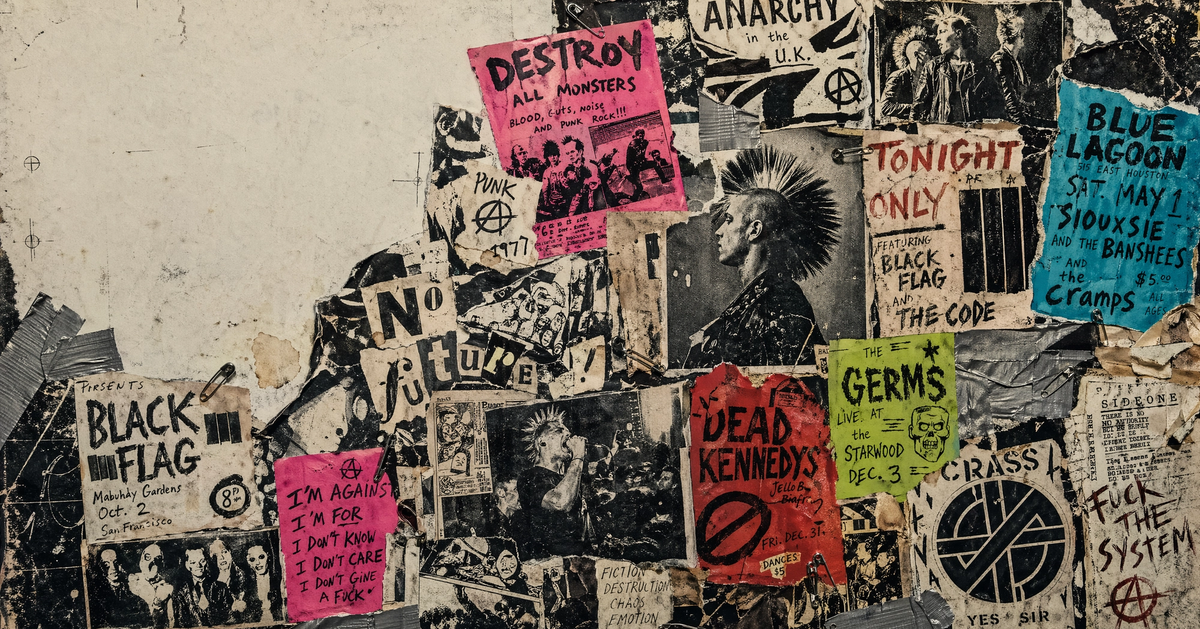
Before the internet, before digital print, the gig poster was the primary graphic output of punk culture. And because there was no digital print, every poster was either screen-printed or photocopied. This meant anyone with access to a screen or a copier could produce one.
The gig poster economy of punk produced an enormous volume of genuinely extraordinary graphic work. The San Francisco scene alone — the Dead Kennedys, DOA, the Avengers, the Germs — generated poster art that borrowed from psychedelic poster design, Soviet propaganda, newspaper layout, and horror film advertising simultaneously. Frank Kozik, Coop, Art Chantry — these designers worked for almost no money because the culture required them to. The output, three decades later, sells for thousands of dollars in galleries.
The design principles of the punk gig poster are identical to the design principles of the best underground streetwear graphics: bold, high-contrast, visually confrontational, referentially dense. They reward close looking. They do not explain themselves. They assume the viewer is intelligent enough to catch the references or curious enough to find out.
In Wyrmfuel lore, Leo Torres draws monsters from a sketchbook and Maze Callahan put the brand's name on a train car before there was a brand. Every character on the roster comes out of this tradition.
Siouxsie Sioux and the Female Punk Visual
The standard punk fashion narrative centres on men. It should not.
Siouxsie Sioux's visual identity from 1976 onwards was among the most developed and deliberate of anyone in the first punk wave. She assembled an image that was sexually confrontational without being conventionally available — bondage gear, extreme eye make-up, fishnet, military references, an increasingly architectural hair construction — that said I am here, I am visible, and I am not here for you to approve of. The look evolved into post-punk and then Goth as Siouxsie and the Banshees' sound evolved, but the core principle held: the appearance was a statement about who controlled it.
Poly Styrene of X-Ray Spex wore bin bags, plastic braces over her teeth, and a kaftan with a plastic badge collection on it — deliberately anti-glamour, deliberately cheap, deliberately wrong. She was a mixed-race British woman in a culture that had very little space for either; her visual presence was an act of occupation of that space.
These were not fashion choices. They were arguments about who got to define what women in public were supposed to look like. The visual language of punk was available to anyone who needed it.
What the Language Means Now
Punk's visual vocabulary has been absorbed by mainstream fashion so many times that the absorption itself has become a subject of cultural commentary. Every major fashion house has done a punk collection. Safety pins have been on the catwalks in Paris and Milan. Ripped denim is sold pre-ripped in shopping centres for £80.
This absorption changes nothing about the language. It just makes the real usage more legible by contrast.
When a brand builds its visual identity from genuine subculture roots — when the graphics come from someone who actually has a sketchbook full of monster drawings, when the name comes from an actual tag on an actual train car — the result looks different from fashion-house punk. It looks like it *means* something. Because it does.
The clothes in the Drip Vault carry this tradition forward. Not by imitating what punk looked like in 1977. By operating from the same principles that produced those clothes: draw what you believe, print it on the best material you can afford, sell it to people who understand why it exists, and never produce more than you need to. The visual language of punk is not a set of aesthetic choices. It is a set of operating principles. That is the inheritance.
FAQ
What is the history of punk fashion?
Punk fashion emerged in London and New York between 1974 and 1977. In the UK it was shaped by Vivienne Westwood and Malcolm McLaren's King's Road shop SEX, by the Sex Pistols and their circle, and by groups like the Bromley Contingent who used extreme dress as a cultural provocation. In the US it developed independently in the New York art-punk scene (Television, Patti Smith, the Ramones) and then evolved into American hardcore in cities like Washington DC, Los Angeles, and Boston from 1980 onwards.
What did punk clothing symbolise?
Punk clothing was a deliberate visual refusal of mainstream culture. Every specific element — safety pins, ripped fabric, writing on clothing, DIY customisation, black as a dominant colour — carried meaning. The clothes said: we are not aspiring to anything your culture offers, we are making our own value system, and we will not hide that it was made by us and not for us.
Who designed punk fashion?
Vivienne Westwood is the most significant individual designer associated with early punk fashion. Her King's Road shop SEX (1974–1976) produced the garments and iconography that shaped the British punk look. Malcolm McLaren (manager of the Sex Pistols) was the creative and commercial force behind the shop and its cultural positioning. In the US, the hardcore visual tradition was shaped not by fashion designers but by graphic artists: Raymond Pettibon (Black Flag, SST Records), Frank Kozik, Art Chantry, and the Misfits' visual design.
What is the difference between punk fashion and goth fashion?
Punk fashion emerged from 1976–1977 and emphasised DIY, confrontation, and anti-establishment messaging. Goth developed from post-punk in the late 1970s and early 1980s — bands like Siouxsie and the Banshees, the Cure, and Bauhaus extended punk's dark visual register into something more theatrical and interior. Where punk was aggressive and outward-facing, goth turned inward. Both shared the use of black, extreme appearance, and reference to transgressive aesthetics.
Is punk fashion still relevant today?
Yes. Punk's visual language is absorbed and commodified by mainstream fashion continuously — but that absorption does not diminish its original principles. DIY ethics, confrontational graphics, the garment as position rather than product — these are actively practised by independent brands and individual customisers who have no interest in heritage punk as nostalgia. The principles of punk fashion are relevant wherever someone uses clothing to declare who they are rather than to signal aspiration toward a pre-approved standard.
What makes a graphic punk?
A punk graphic operates from the same principles as the music: confrontational, specific, not designed to make you comfortable. The best punk graphics — Gee Vaucher's Crass collages, Raymond Pettibon's Black Flag art, the Misfits' Crimson Ghost — are visually aggressive, referentially dense, and assume an informed viewer. They do not explain themselves. They reward knowing them.
What T-shirts did punks wear?
Early UK punks wore items from Vivienne Westwood's SEX shop — ripped, slogan-printed, deliberately offensive. American hardcore punks wore band T-shirts as the primary garment — simple, screen-printed, sold at shows. The band tee became the dominant visual signal of hardcore participation: which bands you wore was a statement of your precise position within the subculture. Screen printing on heavyweight cotton was standard because it was accessible (anyone with a screen could do it) and durable (the print outlasted the fabric).
The Line Runs Forward
The Visual Language of Punk began with a group of teenagers in South London deciding that what they wore was a political act. It ran through a shop on the King's Road, a series of gig posters made on a photocopier, a devilock on a New Jersey singer, a DIY jacket covered in hand-drawn logos at a skate competition.
It runs through a garage in Long Beach, California, in 2025, where two people set up second-hand screens and printed their first tees. The line is unbroken.
If you want to wear something that carries that history forward — not as costume, but as continuation — the Drip Vault is where it lives.